
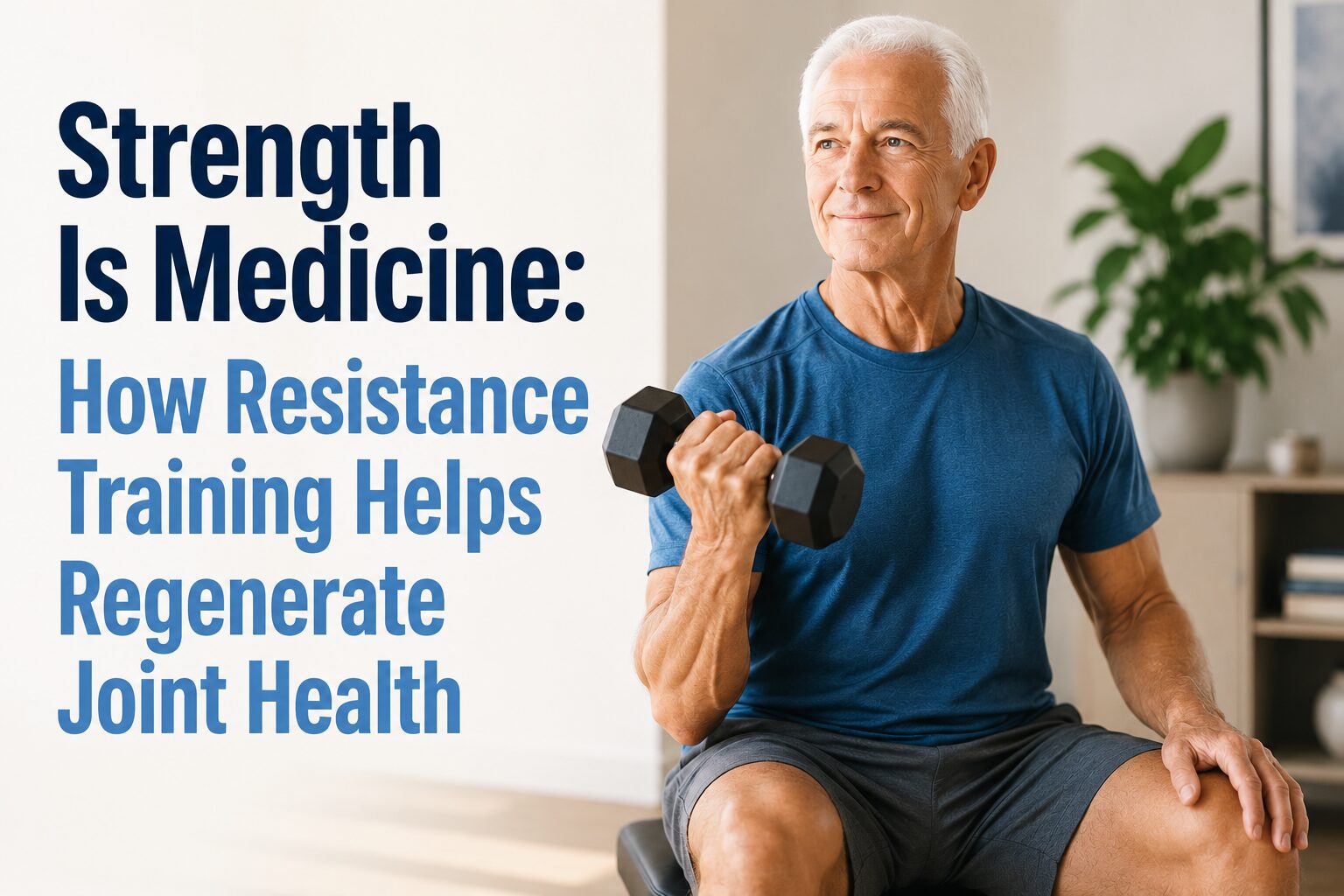
Why the right kind of loading can help joints function better, feel safer, and stay more resilient over time, and why avoiding strength work often makes things worse.
A lot of people with joint pain get stuck in the same discouraging cycle.
The joint hurts, so they move less. They move less, so they get weaker. They get weaker, so the joint becomes less supported. Then the joint hurts even more.
After a while, it starts to feel like the body is shrinking.
Activities that used to feel normal start feeling risky. Confidence drops. People become afraid of aggravating the joint, so they stop asking it to do much at all.
That response is understandable.
It is also one reason joint problems so often get worse over time.
Why Joints Need More Than Rest
When a joint is irritated, rest can feel safer than loading it.
That instinct makes sense in the short term.
But joints are not designed to thrive in long periods of avoidance. They depend on movement, pressure, muscle support, and the right kind of loading to stay healthy.
That is one reason people often feel stiffer, weaker, and less confident the longer they stay away from strength training entirely.
The problem is not always that the joint cannot handle load.
Often the problem is that the load has not been matched well to the joint’s current capacity.
Why Strength Training Helps Joint Health
Strength training helps joints in several important ways.
It improves the ability of muscles to support and guide the joint. It improves force absorption. It improves movement quality. It helps tissue tolerate stress better. And it often helps the nervous system become less protective when the body repeatedly experiences safe, successful load.
That matters because pain is not always just about damaged tissue.
Sometimes pain is also about a joint that no longer feels well-supported, well-coordinated, or trustworthy under demand.
Strength helps change that.
Why “Regenerate” Needs an Honest Explanation
This part matters.
Resistance training is not magic.
It does not mean every damaged joint becomes brand new again. It does not guarantee dramatic tissue change in some simplistic before-and-after way.
But it can improve the biological and mechanical environment around the joint.
It can help the system adapt. It can improve tissue quality. It can improve function. It can reduce overload. It can improve tolerance and resilience.
In real life, that kind of regeneration often looks less like a miracle and more like a joint that works better, hurts less, and holds up more reliably over time.
That is still a big win.
Why So Many People Get This Wrong
A lot of people still think painful joints should mainly be protected from stress.
What they often need instead is smarter stress.
Not reckless loading. Not ego lifting. Not pushing blindly through sharp pain.
But a progressive, well-matched strength strategy that helps the joint and the surrounding system become more capable again.
That is a completely different idea from doing nothing and hoping the problem quiets down on its own.
That is also why generic exercise advice often falls short.
If you do not know what the joint is actually tolerating, what compensation pattern is in play, or which tissues are under-supporting the area, you can easily do too much, too little, or the wrong kind of work.
What Better Strength Work Should Actually Do
Good resistance training for joint health should help:
- improve muscle support around the joint
- increase tolerance to real-life load
- improve coordination and control
- reduce compensation patterns
- build confidence in movement again
- restore capacity without repeatedly provoking the problem
That is why the right plan matters.
The goal is not just to get stronger in a general sense.
The goal is to load the system in a way that builds function, trust, and long-term resilience.
What Better Care Can Look Like
A more useful approach usually starts by figuring out why the joint hurts under load in the first place.
Is the problem tissue irritability, poor force sharing, weak support, bad timing, fear of movement, or a combination of several things?
Once that is clearer, treatment can become more personalized.
The plan can blend hands-on care, progressive loading, movement retraining, and a more customized return to strength so the joint stops feeling like something you have to protect from life.
The Bigger Takeaway
Strength is medicine because the right kind of load helps joints adapt.
If you have been trapped in the cycle of pain, avoidance, weakness, and more pain, the answer is often not less loading forever.
The answer is better loading.
That is how many joints become more stable, more resilient, and more usable again over time.
Not by hiding from stress, but by teaching the body how to handle it better.
Clear Next Step
If joint pain has made you afraid to strengthen, it may be time to stop asking whether loading is bad and start asking what kind of loading your body actually needs.
A better evaluation and training plan can help you figure out how to rebuild support, reduce overload, and make the joint more trustworthy again without just guessing your way through it.
That kind of clarity is what turns exercise from a source of fear into part of the solution.