
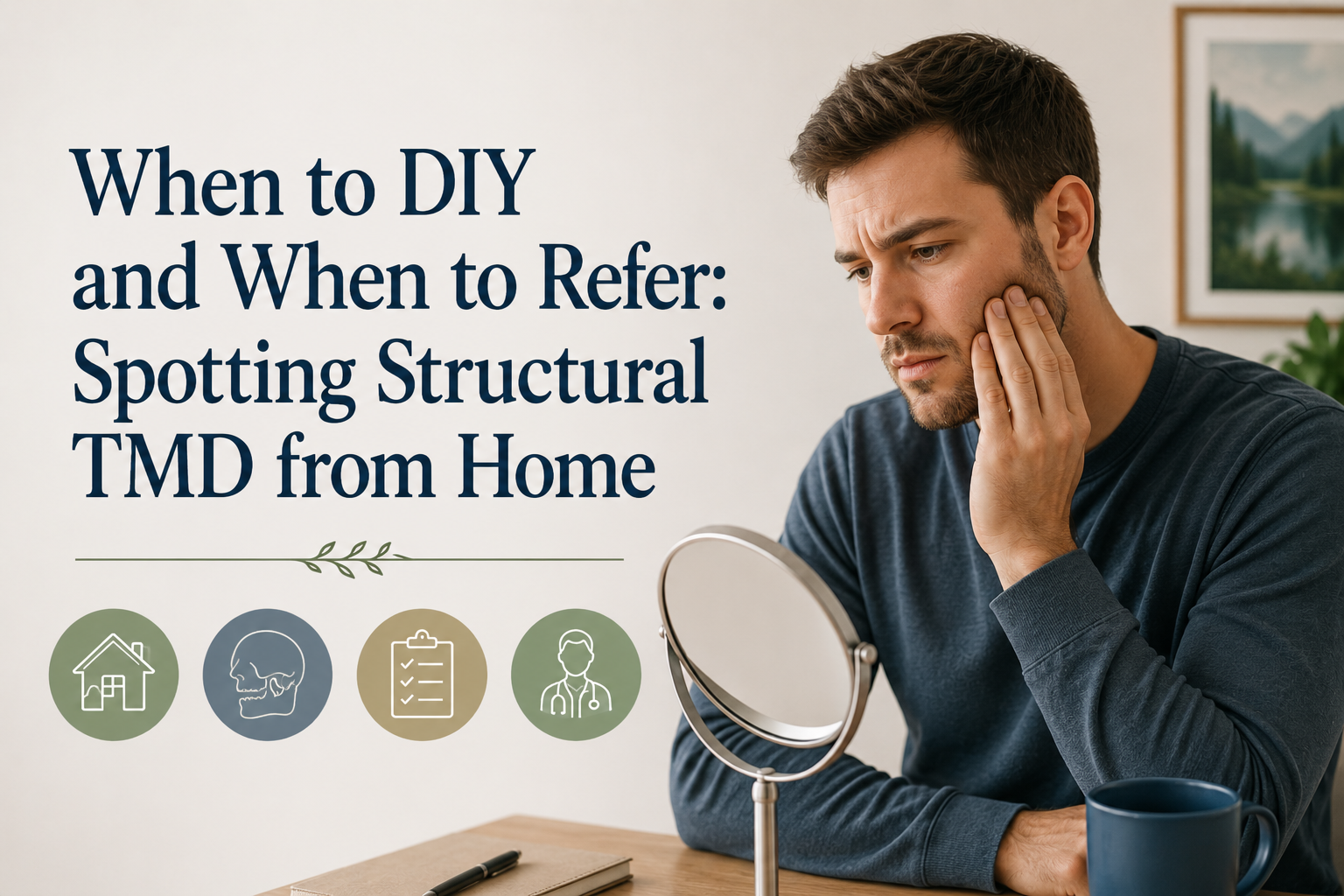
When Kyle’s jaw started clicking, he didn’t think much of it. A little pop when he chewed gum or yawned too wide—no big deal. But over time, that click turned into a painful clunk. Some mornings, he could barely open his mouth. Other days, it would lock shut halfway through a meal. Heat packs and jaw stretches brought only temporary relief.
By the time Kyle came to see me in Ashland, OR, he’d tried everything he could find on the internet. He was ready to do whatever it took. But in his case, the answer wasn’t more exercises—it was a referral.
Not all jaw problems are fixable with self-care. While most cases of TMD are functional and respond well to DIY strategies, some are structural. And trying to stretch or massage your way through a mechanical problem can actually make things worse.
In this post, we’ll cover how to recognize Structural TMD, what red flags to watch for, and when to stop the home care and get expert help.
What Is Structural TMD?
Structural TMD refers to mechanical problems within the temporomandibular joint (TMJ) itself. These often involve:
- Disc displacement
- Joint locking (open or closed)
- Bone degeneration
- Congenital abnormalities
- Post-traumatic changes
This isn’t a muscle problem or a breathing/posture issue. It’s an internal derangement of the joint that typically requires dental or medical co-management.
Signs You Might Have Structural TMD
While a full diagnosis requires imaging and clinical assessment, there are several red flags you can watch for at home:
1. Locking That Lasts More Than 7 Days
If your jaw gets stuck open or closed and doesn’t resolve within a week, you may have a disc that is displaced without reduction. That means it’s not moving back into place, and conservative care may be limited.
2. Joint Noises with Pain or Limited Opening
A painless click here or there is normal. But a consistent clunk—especially if it’s painful and tied to limited motion—may signal internal derangement.
3. Deviation Without Correction
Watch your jaw in the mirror as you open. If it curves to one side and never returns to center, this could indicate structural dysfunction on the side it deviates toward.
4. Limited Opening (<35mm or <3 Fingers)
A structurally restricted joint often can’t open fully, even with soft tissue work. If you can’t comfortably fit three vertical fingers between your front teeth, there may be a mechanical block.
5. History of Trauma or Connective Tissue Disorder
Previous facial injuries, jaw dislocations, or systemic hypermobility conditions (like Ehlers-Danlos Syndrome) increase the likelihood of structural TMD.
What You Can (and Can’t) Do at Home
While Structural TMD requires professional support, there are still safe things you can do to minimize symptoms:
✅ DO:
- Use heat or ice for pain relief
- Practice good jaw rest posture (tongue on palate, lips closed, teeth apart)
- Avoid wide mouth opening (e.g., big bites, yawning aggressively)
- Stick to soft foods to reduce joint load
- Maintain nasal breathing and upright posture
🚫 DON’T:
- Forcefully stretch your jaw
- Use aggressive massage or devices
- Push through locking episodes
- Self-manipulate your jaw
Who Should You See?
If you suspect structural TMD, here’s your referral roadmap:
1. Dentist with TMD Training
They can evaluate for disc position, prescribe occlusal splints or bite guards, and refer for imaging (like MRI or CBCT).
2. Chiropractor or Physical Therapist Familiar with TMD
While they won’t fix a disc, they can help manage coexisting cervical and muscular issues—and coordinate care with your dentist.
3. Oral & Maxillofacial Surgeon
In rare cases where splints and rehab fail, surgical evaluation may be necessary.
A Patient Story: When Referral Makes All the Difference
When I first saw Kyle, he had limited jaw opening, a consistent leftward deflection, and a loud, painful clunk at about 20mm of opening. He could only fit two fingers in his mouth.
We trialed some light mobility and postural retraining, but after two sessions, there was no change. I referred him to a local dentist specializing in TMJ care. Imaging confirmed an anteriorly displaced disc that wasn’t reducing.
He began splint therapy and returned to my care for cervical stabilization and stress management. Within six weeks, his symptoms had improved dramatically. His mouth opened fully, and the pain and clunking were nearly gone.
Final Thoughts
Structural TMD isn’t something you can fix with YouTube exercises or a foam roller. But it’s not the end of the road, either.
Knowing when to stop DIY care and seek professional help is part of healing smarter. If your jaw is locking, deviating, or not responding to gentle movement and breathwork, don’t keep pushing. Get a team behind you—a dentist, a chiropractor, maybe even a surgeon.
The right diagnosis makes all the difference. And once you have it, your path to recovery becomes much clearer.
If you’re unsure whether your TMD is structural, functional, or a combination, reach out. My clinic in Ashland, OR is here to guide you toward the care that makes sense for your story. Because no one should have to navigate this jungle of jaw pain alone.