
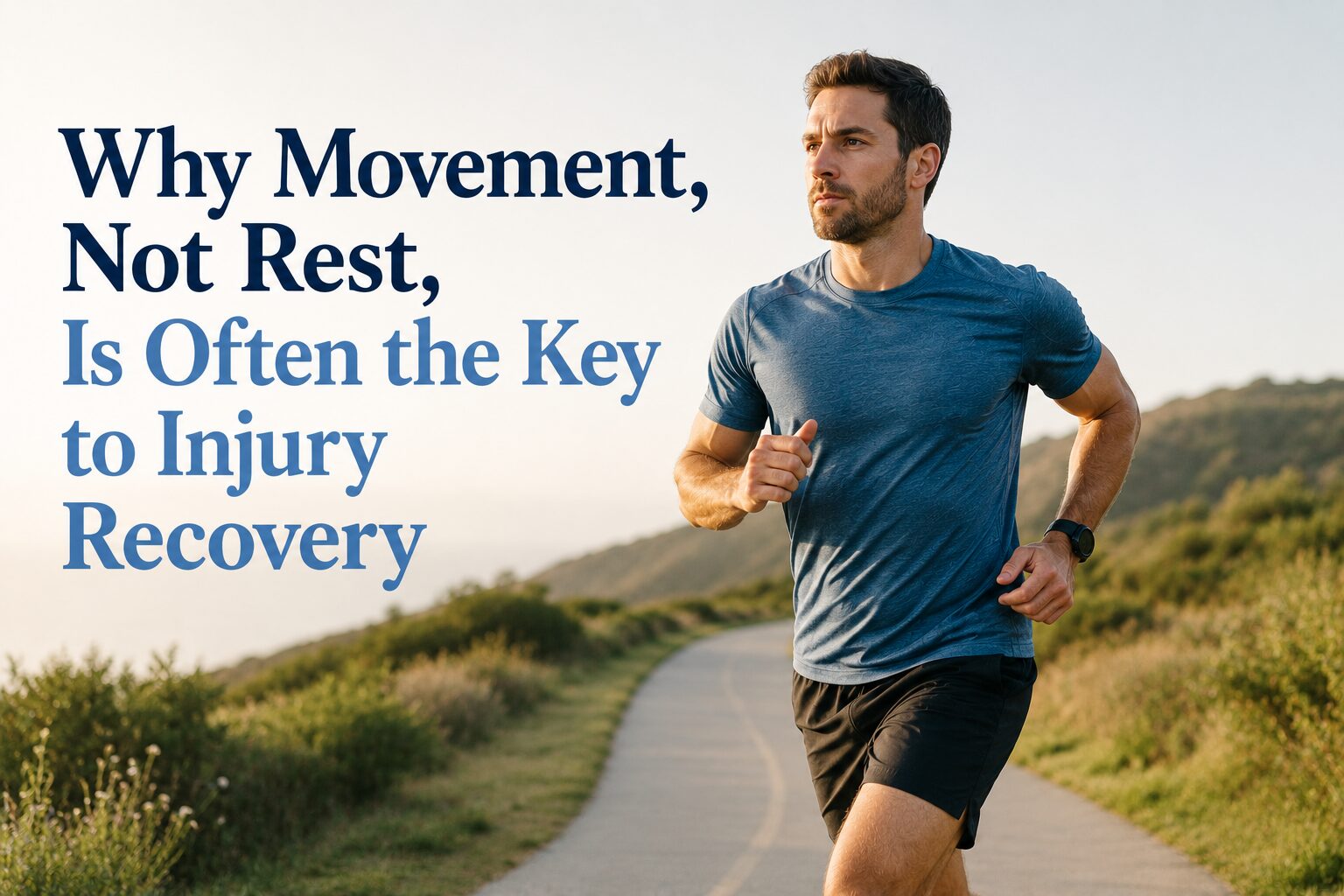
Why the right kind of movement often restores healing, strength, and confidence faster than prolonged rest alone.
When people get hurt, one of the first instincts is usually the same.
Stop moving. Rest it. Protect it. Wait.
That instinct makes sense. Pain feels like a warning, and no one wants to make an injury worse.
The problem is that while rest has a role, too much rest often becomes part of the reason recovery drags on.
For many injuries, the body does not just need protection. It also needs the right kind of input to heal, remodel, regain coordination, and rebuild trust in movement.
That is why, in so many cases, movement is not the enemy of recovery. It is part of the solution.
Why Rest Helps, but Only Up to a Point
In the very early phase of an injury, rest can be important.
Sometimes irritated tissues need a temporary reduction in load. Sometimes pain needs to calm down before the next step is possible. Sometimes the smartest move is to stop doing the exact thing that keeps provoking the area.
But that is different from shutting the whole system down for too long.
Extended inactivity often creates new problems:
- stiffness
- weakness
- loss of coordination
- reduced circulation
- greater pain sensitivity
- more fear with movement
- lower confidence in the injured area
At a certain point, the body stops benefiting from pure rest and starts paying for it.
Why Smart Movement Speeds Recovery
Healing tissues respond to load.
Not reckless load. Not random load. Not “push through it no matter what.”
But appropriate, graded, well-timed load.
The right movement can help:
- improve circulation
- reduce stiffness
- maintain mobility
- restore normal movement patterns
- improve tissue tolerance
- reduce protective guarding
- rebuild confidence in the injured area
This is one reason so many people feel better once they start moving again in a more intentional way.
The pain may not vanish overnight, but the body begins getting the signals it needs to adapt.
Why Too Much Protection Can Backfire
A lot of injuries do not just become a tissue problem. They become a protection problem.
The body starts guarding. Movement gets smaller. People become more cautious. Certain motions start to feel dangerous even when the tissue could tolerate more than the person expects.
That protective response is understandable, but if it stays in charge too long, recovery often stalls.
Now the injury is mixed with fear, avoidance, stiffness, and underuse.
That is a very different problem from the original strain, sprain, or flare-up.
The Goal Is Not More Movement. It Is Better Movement.
This is the part many people miss.
The answer is not simply “move more” in a vague way. The answer is to find the type, direction, dosage, and timing of movement that helps the body recover instead of irritating it.
That may mean:
- gentle range-of-motion work early
- walking when more aggressive exercise is too much
- gradual strength work as tolerance improves
- reintroducing specific movements in stages
- choosing movements that reduce symptoms instead of provoking them
- restoring normal mechanics instead of compensating around the injury forever
In other words, the key is not heroic effort. It is intelligent progression.
Why Recovery Is Also About Confidence
One of the quietest but most important parts of healing is confidence.
People often do not just lose strength when they get hurt. They lose trust.
They stop trusting the shoulder, the knee, the back, the ankle, the neck, or whatever area has been painful. And once trust is gone, movement becomes hesitant, guarded, and inefficient.
Smart movement helps rebuild that trust.
It reminds the nervous system that the body is still capable, still adaptable, and not permanently broken.
That matters more than many people realize.
What Better Injury Recovery Should Look Like
Good recovery is not built around avoiding all discomfort forever. It is built around helping the body become more capable over time.
That often means:
- respecting the irritated phase without getting stuck in it
- reintroducing movement before deconditioning takes over
- matching the exercise to the stage of healing
- improving mechanics instead of just surviving symptoms
- increasing tolerance step by step
- using movement as part of recovery, not just as a test of recovery
The Bigger Takeaway
Rest has a role, but it is rarely the whole answer.
For many injuries, the longer-term win comes from knowing when and how to start moving again in a way the body can use.
Movement is often what helps tissues heal, stiffness soften, strength return, and confidence come back.
That is why the goal is not to rest until life feels safe again.
The goal is to move in a way that helps the body become resilient enough to return to life.