
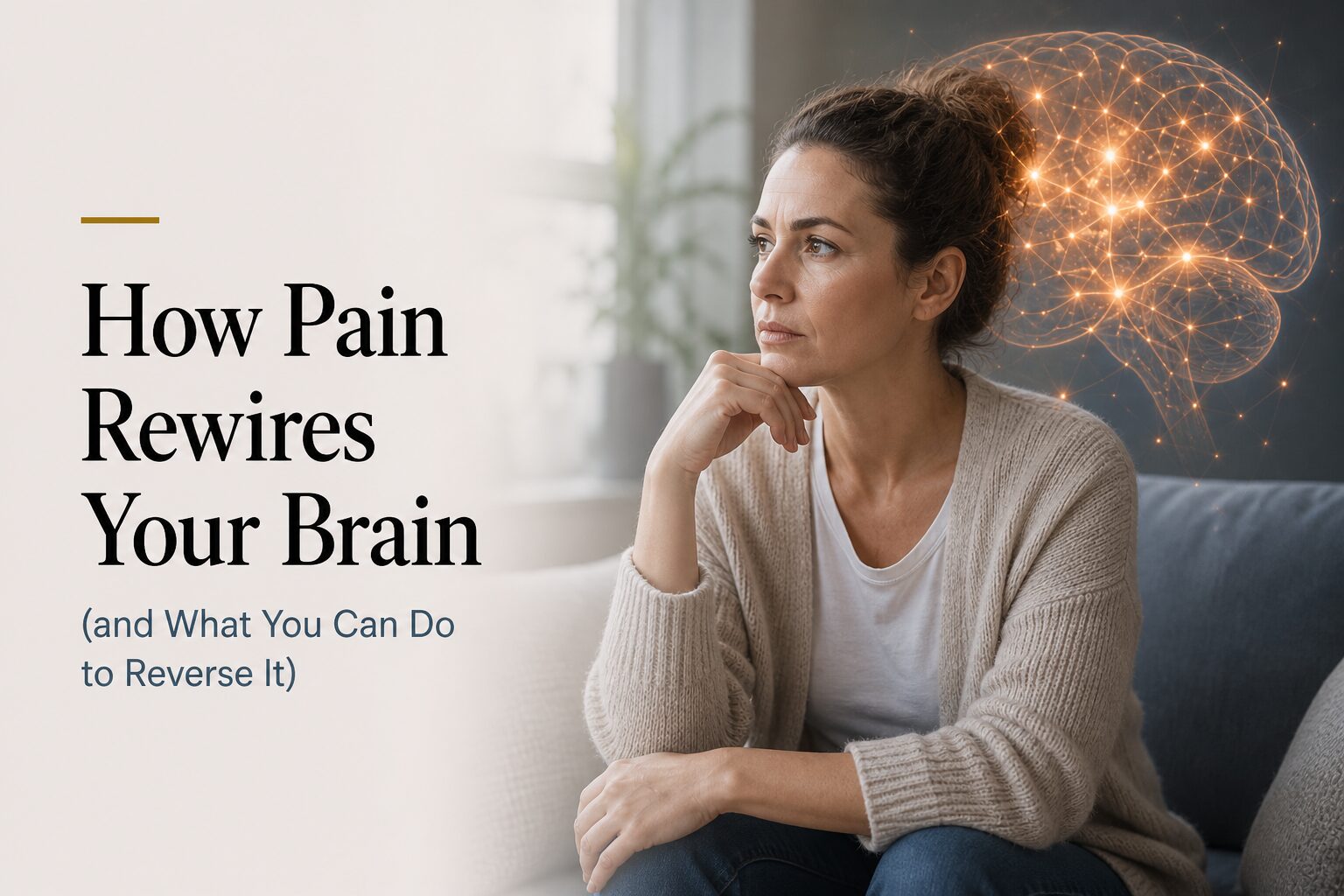
Why persistent pain changes protection patterns, not just sensation, and why recovery often requires changing the brain’s response as much as the body part itself.
When pain sticks around, it does not just affect the body part that hurts.
It also changes the way the brain and nervous system process threat, movement, and protection.
That matters because persistent pain is not just an unpleasant sensation living in one area. Over time, it becomes a pattern the nervous system learns, predicts, and reinforces.
That is one reason people can feel trapped in pain long after they expected the tissue itself to calm down.
What It Means for Pain to “Rewire” the Brain
When people hear that pain can rewire the brain, they sometimes assume this means the pain is imaginary.
That is not the point at all.
The pain is real. The point is that the nervous system is adaptable, and it can adapt in both helpful and unhelpful directions.
If a painful body part keeps sending threat signals, or if the system keeps expecting danger with certain movements, the brain often becomes more efficient at producing protection.
That protection may show up as:
- more pain with less provocation
- faster guarding
- more sensitivity to normal movement
- more tension around the painful area
- more certainty that certain actions are unsafe
In other words, the brain gets better at predicting pain.
That is useful in the short term if the body truly needs protection.
It becomes a problem when the protection pattern outlasts the situation that originally created it.
Why Persistent Pain Feels So Different
This is one reason long-standing pain often behaves differently from a simple acute injury.
At first, pain may be closely tied to tissue irritation. But over time, the nervous system often becomes part of the problem in a bigger way.
Now the person may notice things like:
- pain spreading more easily
- more sensitivity to load
- pain with normal movement that used to feel safe
- fear around certain positions or activities
- repeated cycles of flare, guarding, and avoidance
The pain may feel more unpredictable. The body may feel less trustworthy. And the person may start wondering whether they are somehow failing recovery.
Usually they are not.
Usually the system has simply learned too much protection.
Why This Makes Recovery Harder
Once the brain learns pain well, it starts predicting it faster.
That means normal movement can begin to feel threatening even when the original tissue injury is no longer the whole explanation.
Now the person is not dealing only with damaged tissue. They are dealing with a changed relationship between the body, the brain, and the expectation of danger.
That is why purely local treatment often stops being enough.
You can calm the tissue somewhat and still have a system that is ready to overprotect the moment the person bends, reaches, walks, lifts, or moves in a way the brain still distrusts.
What Helps Reverse the Pattern
If pain can be learned, it can also be unlearned.
Not instantly. Not by pretending nothing hurts. And not by pushing recklessly through everything.
But the same nervous system that became more efficient at protection can also become more efficient at safety.
That usually happens through repeated, tolerable, believable experiences that teach the system something new.
That may include:
- graded movement
- restoring confidence in normal load
- reducing fear and avoidance
- calming unnecessary guarding
- improving sleep and recovery
- improving the body part’s actual capacity
- creating repeated experiences of movement that do not end in threat
The goal is not just pain suppression. The goal is to help the brain stop predicting danger where danger is no longer the best explanation.
Why Education Matters So Much
This is one reason a better explanation can itself be therapeutic.
If someone believes their pain always means more damage, they often move more cautiously, brace more aggressively, and become more sensitive to any flare.
If they understand that pain can reflect protection, prediction, and nervous system learning, the whole recovery process often becomes more workable.
They do not feel crazy. They do not feel broken beyond repair. They understand that the system has adapted in a way that can be changed.
That shift matters.
The Bigger Takeaway
Pain can rewire the brain, but that process is not one-way.
The nervous system is adaptable. It can learn more danger, but it can also learn more safety. It can become more protective, but it can also become more confident. It can amplify pain, but it can also gradually loosen its grip when the right inputs are repeated often enough.
That is one reason recovery remains possible even in long-standing pain.
The goal is not just to make the pain disappear for a moment.
The goal is to change the whole pattern so the body stops living in a state of constant overprotection.