
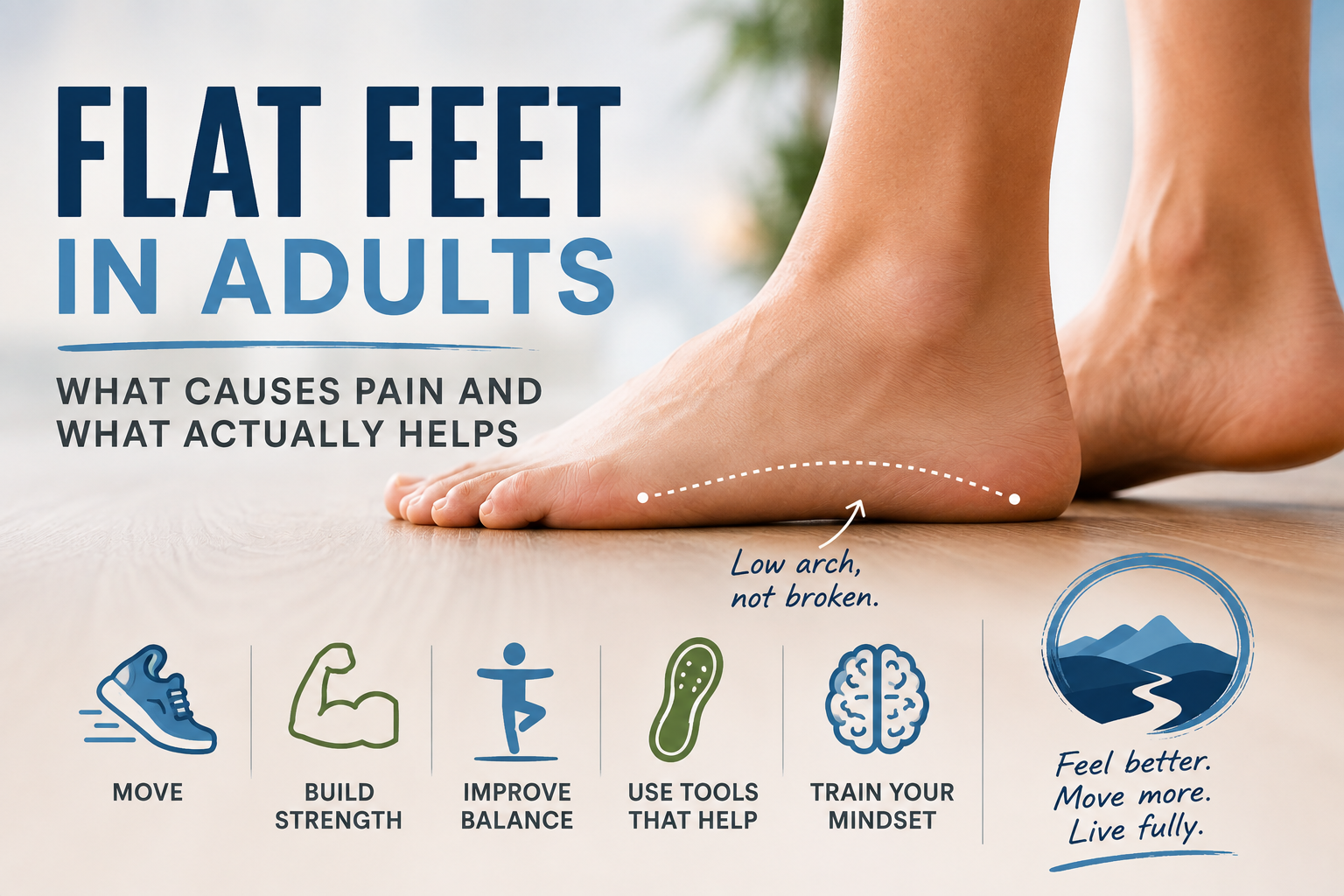
Why a low arch is not automatically a problem—and why strength, movement, shoes, stress, and confidence may matter more than the shape of your foot.
If you have flat feet, you may have been told something is wrong with you.
Your arches have “fallen.”
You “overpronate.”
Your feet are causing your knee pain.
Your hips are out of line.
Your back hurts because everything started at your feet.
That sounds scary.
It is also much too simple.
Flat feet are not automatically bad feet.
Many people have low arches their whole lives and never have pain. They walk, run, hike, work, and play sports without thinking about their feet at all.
So the real question is not:
Are my feet flat?
A better question is:
Can my feet comfortably handle what I ask them to do?
That small change in thinking makes a big difference.
Think of Your Foot Like a Spring
Your foot has 26 bones, many joints, muscles, tendons, and ligaments.
It is not supposed to be a stiff block.
Think of it more like the suspension system on a car.
When your foot hits the ground, it needs to soften a little. This helps it absorb force.
Then, as you push off, it needs to become firmer so you can move forward.
Your arch is part of that system.
When you put weight on your foot, the arch normally lowers a little. This motion is called pronation.
Pronation is not a mistake.
It is something healthy feet do.
The problem is not simply that your arch moves.
The problem may come when the foot cannot control that movement or cannot tolerate the amount of work you are asking it to do.
Flat Feet Are Not the Same as Painful Feet
Imagine two people who both have very flat feet.
One hikes ten miles every weekend without pain.
The other gets aching feet after walking around the grocery store.
Their feet may look almost the same.
But their capacity is very different.
That tells us something important:
Shape does not tell the whole story.
Pain may depend on several things:
- how strong your feet and calves are
- how well your ankle moves
- how well you balance
- how quickly your activity increased
- what shoes you wear
- how much time you spend standing
- an old ankle or foot injury
- how well your hips and legs control movement
- sleep and recovery
- stress
- how sensitive your nervous system has become
This is why simply looking at someone’s arch does not explain everything.
The Three Questions That Matter More Than Arch Height
Instead of asking only whether a foot is flat, it can be more useful to think about three things.
1. What Shape Is the Foot?
Foot shape still matters.
Some people have high arches. Some have low arches. Some are somewhere in the middle.
Your arch may also change when you stand.
If you have an arch while sitting but it flattens when you stand, you may have what is called a flexible flat foot.
That can simply be the way you are built.
2. What Can the Foot Do?
This is often more useful.
Can you:
- stand on one leg?
- rise onto your toes?
- walk without pain?
- climb stairs?
- run if you want to run?
- walk barefoot comfortably?
- handle a long day on your feet?
- control your foot when it lands?
Think of your arch like a bridge.
The shape of the bridge matters.
But so do the cables, supports, and foundation underneath it.
Your muscles and tendons are some of those supports.
A low bridge with strong supports may work perfectly well.
3. How Sensitive Is the System?
This is the part people often miss.
Pain does not come only from the shape of your foot.
Pain is also an alarm created by your nervous system.
Imagine a smoke alarm.
You want the alarm to warn you when there is a real fire.
But a very sensitive alarm may also go off when you make toast.
The same thing can happen with pain.
If your foot has been painful for months, your nervous system may become more protective.
Then normal pressure, walking, or movement can start to feel more threatening than it used to.
This does not mean the pain is imaginary.
It means recovery may involve more than changing mechanics.
Sometimes you also need to teach your nervous system that your foot is safe to use again.
Can Flat Feet Cause Knee, Hip, or Back Pain?
This is one of the most common questions people ask.
The answer is:
Sometimes—but not automatically.
When the foot rolls inward, the lower leg can also rotate inward.
That movement can change how force travels through the knee and hip.
But your body is not a stack of blocks where one crooked piece ruins everything above it.
Your body adapts.
A runner with flat feet may have excellent hip strength and control.
Someone with a beautiful-looking arch may still have knee pain.
That is why I would be careful with anyone who looks at your feet for ten seconds and tells you they are the root cause of everything happening in your body.
The foot may be part of the puzzle.
It is rarely the entire puzzle.
Why Flat Feet Sometimes Start Hurting
Many painful feet are not failing because they suddenly became “bad.”
Sometimes the problem is simply that demand became greater than capacity.
Think about lifting weights.
If you can comfortably lift 30 pounds but suddenly try to lift 100 pounds all day, you may get sore.
Your feet work the same way.
Maybe you:
- started walking more
- changed jobs and now stand all day
- began running
- increased your hiking mileage
- switched shoes
- stopped exercising for several months
- returned to activity after an injury
Your foot may simply not have been ready for the jump.
This gives us a much more hopeful way to think about the problem.
Instead of:
My feet are damaged.
Try:
My feet may need more capacity.
Those are very different stories.
Can You Strengthen Flat Feet?
Yes.
You may not completely change the shape of the foot you were born with, and you do not necessarily need to.
But you can often improve how the foot works.
Research on exercises that train the small muscles of the foot suggests that several weeks of practice can improve arch control in people with flat feet.
The goal is not to force your foot into a perfect-looking arch.
The goal is to build a foot that handles load better.
A useful program may include:
Foot Control
Try gently lifting the arch without curling your toes.
Imagine making your foot slightly shorter by drawing the ball of your big toe toward your heel.
This is sometimes called a short-foot exercise.
Calf Raises
Your calf and foot muscles work together every time you walk.
Slow heel raises can help build that system.
Start with both feet.
Later, progress toward one foot if it feels comfortable.
Balance
Standing on one leg teaches your brain where your foot is in space.
This improves communication between the foot and nervous system.
Walking
Do not underestimate walking.
Walking itself can be training when the amount is matched to your current ability.
Start with an amount that feels safe and build slowly.
What About Orthotics?
Orthotics can help some people.
But I think they are often explained poorly.
An orthotic is not necessarily a device that puts your skeleton back into the “correct” position.
Think of it more like a hiking pole.
If your knee hurts on a steep trail, a hiking pole can take some stress off the knee.
That does not mean your leg is broken.
It is simply a tool that changes how the load is shared.
Orthotics can work the same way.
They may:
- make walking more comfortable
- change how pressure moves through the foot
- reduce stress on an irritated area
- help someone stay active while building strength
Some people love them.
Some people notice little difference.
And not everyone with flat feet needs them.
Research on orthotics for flat feet is mixed. They can change how forces move through the foot and leg, and they may help some people with pain, but there is not strong evidence that every flat foot should be treated with an orthotic.
I would not think of orthotics as either good or bad.
They are a tool.
The question is whether that tool helps you do more with less pain.
Do You Need Special Shoes for Flat Feet?
Not always.
There is no single perfect shoe for every flat foot.
A simple rule is often more helpful:
Choose shoes that feel comfortable and let you do what you want to do.
Some people feel better with more support.
Others prefer a softer shoe.
Others prefer less shoe.
Your foot is not failing simply because it prefers support.
And wearing supportive shoes does not automatically make your feet weak.
The goal is not to win an argument about footwear.
The goal is to find what lets you move comfortably while continuing to build capacity.
Your Mindset About Your Feet Matters Too
This may be the most overlooked part.
Words matter.
Imagine being told:
“Your arches have collapsed.”
“You have terrible feet.”
“Your feet are destroying your knees.”
“You will always need orthotics.”
What happens next?
You may start watching every step.
You may stop walking barefoot.
You may avoid running.
You may become afraid to load your feet.
And over time, doing less can make the feet less prepared to do more.
The story can become a loop:
Pain → fear → less movement → less capacity → more pain.
Sometimes recovery means breaking that loop.
Instead of seeing your feet as fragile, you begin treating them as adaptable.
Instead of asking:
How do I protect my feet forever?
Try asking:
How do I help my feet become better at doing the things I care about?
That is a much more useful question.
When Flat Feet Should Be Checked
There are times when foot shape deserves a closer look.
Pay more attention if:
- one arch suddenly starts getting flatter
- only one foot is changing
- you have swelling or pain along the inside of the ankle
- you cannot rise onto your toes on one leg
- your foot is becoming very stiff
- walking is becoming harder
- your foot shape is changing quickly
- pain continues to get worse despite reducing the load
A foot that has always been flat and comfortable is very different from a foot that is becoming flat and painful.
That difference matters.
A Simple Way to Think About Flat Feet
If you remember only one thing from this article, remember this:
Flat does not mean broken.
A low arch is one piece of information.
It does not tell you how strong your foot is.
It does not tell you how well you move.
It does not tell you how much you can walk.
And it does not tell you whether you should be in pain.
When flat feet hurt, the answer is usually not to chase the perfect arch.
It is to ask better questions.
What changed?
What is overloaded?
What is weak?
What is stiff?
What is the nervous system protecting?
And how can we slowly build more capacity?
That turns flat feet from a scary diagnosis into something much more useful:
a movement problem that can often be understood, trained, and adapted to.
Frequently Asked Questions About Flat Feet
Are Flat Feet Bad?
Not necessarily. Many adults have flat feet and never have pain. Foot shape by itself does not tell us whether the foot is healthy.
Can Flat Feet Be Fixed?
You may be able to improve foot strength and arch control, but you may not need to change the natural shape of your foot. The more important goal is comfortable, confident movement.
Can Flat Feet Cause Plantar Fasciitis?
Flat feet can change the way the foot handles load and may be one factor in plantar heel pain. But plantar fasciitis usually has several possible causes, including changes in activity, calf strength, tissue capacity, footwear, and recovery.
Can Flat Feet Cause Knee Pain?
They can influence how force moves through the leg, but flat feet do not automatically cause knee pain. Hip strength, activity level, previous injuries, training load, and many other factors can also matter.
Should I Wear Orthotics for Flat Feet?
Not just because your feet look flat. Orthotics may be useful if they reduce pain or help you stay active, but they are only one possible tool.
Can Exercises Help Flat Feet?
Yes. Exercises that build foot control, calf strength, balance, and overall leg strength can improve how the foot handles load. Research suggests that several weeks of foot-strengthening exercise may improve arch control.
Is Walking Barefoot Bad for Flat Feet?
Not automatically. Some people with flat feet are very comfortable barefoot. Others prefer support. Like any activity, barefoot walking can be increased slowly if your feet are not used to it.
Why Did My Flat Feet Suddenly Start Hurting?
Often something changed. You may be walking more, standing longer, running farther, wearing different shoes, recovering from an injury, or simply asking more from the foot than it is currently ready to handle. A new or rapidly changing flat foot should be evaluated.
The Bigger Takeaway
Your feet are not statues.
They are living, changing parts of a much larger movement system.
They sense the ground.
They absorb force.
They adapt.
They get stronger.
And your brain is constantly learning whether it can trust them.
So if you have flat feet, do not start with the assumption that something is wrong.
Start with curiosity.
What can my feet do now—and what could I teach them to do next?
That is often where real progress begins.