
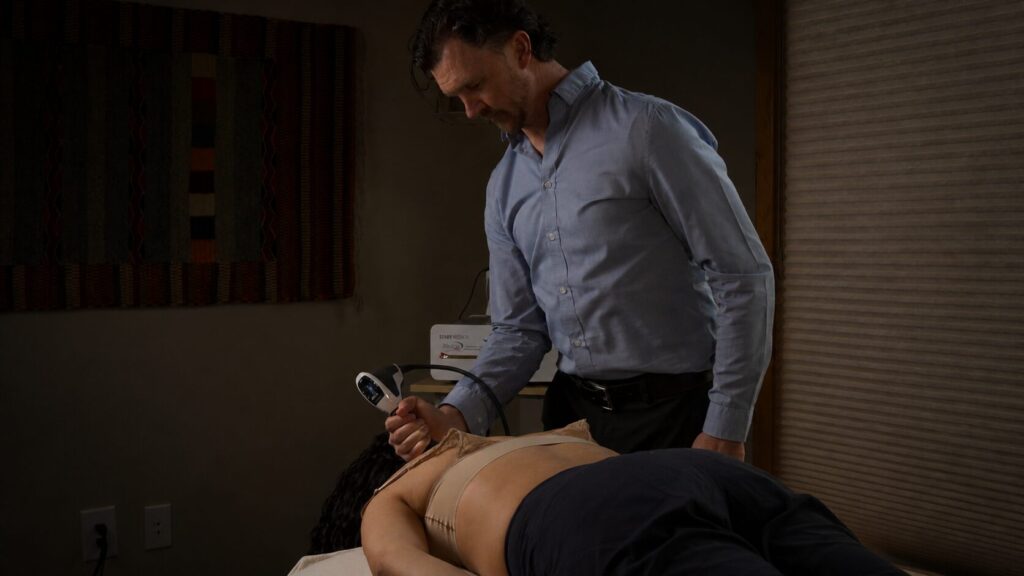
When Tissue Recovery Needs More Than Routine Care
Shockwave Therapy for Auto Accident Injuries
This page focuses on where shockwave therapy may fit in post-collision care and where it does not belong as a default answer.
Where shockwave may fit
Shockwave therapy may be useful when a soft-tissue problem remains stubborn and recovery has plateaued, especially in cases where tissue irritation or chronic sensitivity seems to be part of the picture.
- Lingering soft-tissue pain
- Tender areas that have not fully settled
- Movement-limited pain after the acute phase
- Cases where recovery has stalled
What it should not be
Shockwave should not be treated like a magic bullet. It is most useful when it is matched to the right tissue pattern, symptom behavior, and overall recovery plan.
How Dr. Noah Volz positions it
At DNV, shockwave is part of a more comprehensive recovery model. It is considered when it fits the case, not because every accident patient needs a gadget-driven treatment path.
Why this matters for post-collision care
A more complete treatment strategy helps separate useful tools from unnecessary ones. That is part of what makes the overall approach more personalized and more credible.
Shockwave can make sense in some recovery plans, but it should not be the headline unless it truly fits the case. The real differentiator is knowing when a modality supports recovery and when it is just noise.
From a positioning standpoint, this also helps DNV avoid sounding like a gadget clinic. The value is not that shockwave exists. The value is knowing when it actually belongs in a smarter recovery plan.
Related pages
This Ashland post-collision cluster is designed to work together. These pages should support each other in both user flow and local search visibility.
- Car Accident Chiropractor in Ashland, OR
- Oregon PIP Coverage for Chiropractic Care After a Car Accident
- Whiplash Treatment in Ashland, OR
- Neck Pain After a Car Accident in Ashland
- Back Pain After a Car Accident in Ashland
- Dizziness After a Car Accident
- Shoulder Pain After a Car Accident in Ashland
- Shockwave Therapy for Auto Accident Injuries
- Direct Current Therapy for Auto Accident Recovery